How rare is a full-Moon birthday? A 126-year calendar study
Published on · Reviewed on
From 1900 through 2025, 1,558 of 46,021 calendar dates contained the instant of a full Moon: 3.39%, or about one date in 29.5. That is a share of calendar dates, not a measured percentage of people. Your local time zone decides which date counts.
A birthday and a full Moon can share a date without sharing an exact instant. We calculated every full Moon across 126 years, converted the results into seven local time zones and checked how often the same birthday came around again. The familiar 19-year rule helped—but it did not keep every appointment.
What the calendar study found
Each of the seven time zones had 1,558 full-Moon dates between January 1, 1900 and December 31, 2025. The total was the same; many individual dates were not. London and New York assigned 317 of those full Moons to different calendar dates.
In London, January 5 fell on a full Moon seven times, the highest count for an ordinary month-and-day in this period. Six dates did so only once. This is a description of one historical window, not a ranking of lucky birthdays or a forecast that January 5 will always lead.
February 29 needs a different denominator. It occurred only 31 times in these 126 years. London had a full Moon on that date in 1972; New York and Mexico City had none. Comparing a leap-day birthday with 126 ordinary birthdays would exaggerate the difference.
| Reference time zone | % |
|---|---|
| New York | 57.4 |
| London | 59.5 |
| Madrid | 60.5 |
| Mexico City | 59.3 |
| Rome | 59.8 |
| Paris | 60.5 |
| Berlin | 59.6 |
Look up your birthday and time zone
Choose a month, day and one of the seven time zones. The historical result covers 1900–2025. The future list searches 2026–2100 and uses the time-zone rules available when this study was calculated. It does not establish whether the Moon was above your horizon or whether clouds hid it.
Use your actual local zone when it is included. New York does not represent every US location, London does not represent every English-speaking country, and Mexico City does not cover all of Mexico. A result near midnight deserves a check against a specialist ephemeris before you use it for an exact historical claim.
Loading the data…
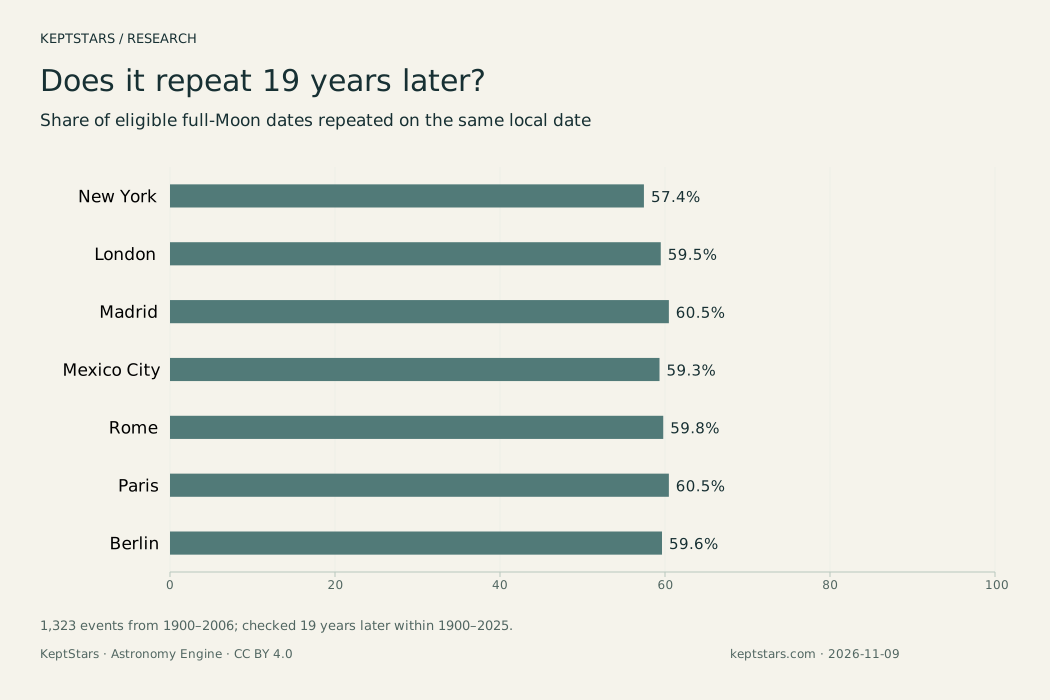
Does a full-Moon birthday repeat every 19 years?
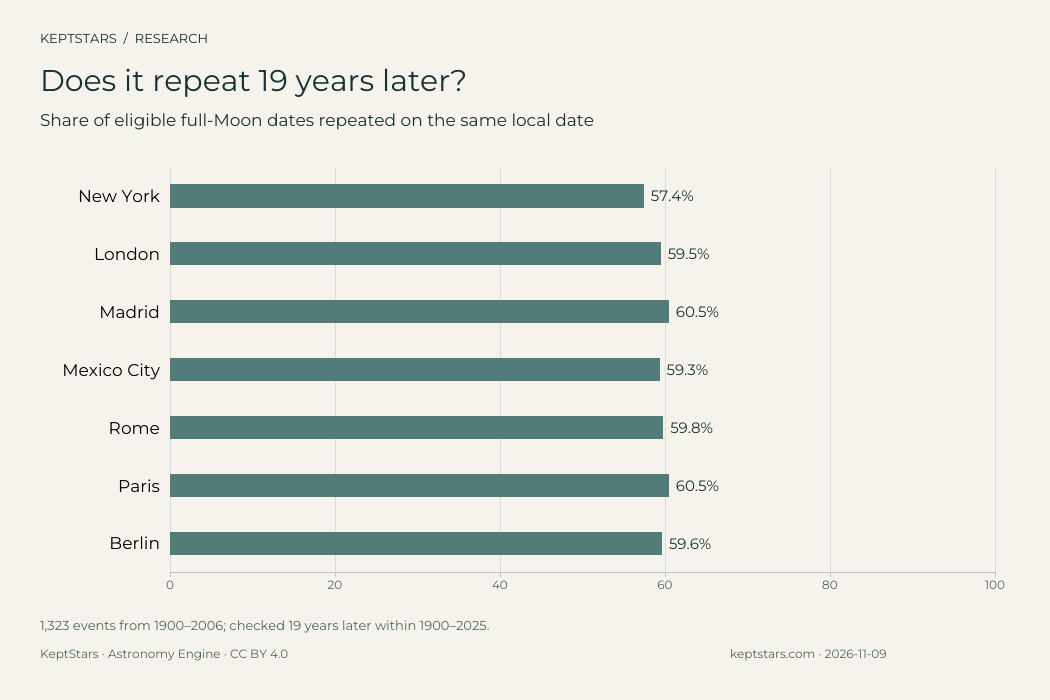
Often, but not reliably on the same local date. We took the 1,323 full-Moon dates from 1900–2006, leaving enough room to check each date again 19 years later within the study.
In London, 787 of those 1,323 dates repeated exactly 19 years later: 59.5%. The share ranged from 57.4% in New York to 60.5% in Madrid and Paris. Nearly matching lunar and calendar cycles do not guarantee an exact date match; the hour, leap days and changes in local clock rules matter.
January 5 illustrates how convincing a run can look. London had full Moons on that birthday in 1901, 1920, 1939, 1958, 1977, 1996 and 2015. Those repeated 19-year steps are real. They still do not turn the pattern into a promise for every date.
One full Moon can belong to two birthdays
Consider the full Moon on April 13, 2025 at about 00:23 Universal Time. That was already April 13 in London, Madrid, Rome, Paris and Berlin. In New York and Mexico City it was still April 12.
The astronomical event did not happen twice. Local clocks placed the same instant on different dates. This is why a birthday lookup needs a time zone, even though the phase event itself is calculated for Earth as a whole.
It also explains a common mix-up. A Moon that looks full on your birthday is a broader test than the one used here. Its appearance changes gradually around the calculated full phase. This study counts only the calendar date containing the defined instant; it does not label every almost-full evening as another full-Moon birthday.
Method, validation and limits
We used Astronomy Engine 2.1.19 to find the moments when the Moon’s geocentric ecliptic longitude was 180 degrees from the Sun’s. In plain terms, this is the conventional geometric definition of the full phase. We assigned each moment to a local Gregorian date using the IANA time-zone data bundled with Node.js 24.22.1 (tz 2026e).
Our historical window contains 46,021 dates, including 31 leap days. The calculation is not weighted by birth records, so 3.39% must not be described as the percentage of babies born under a full Moon. Nor does this work test a connection between lunar phases and the timing of births.
For an independent check, we compared 1,237 calculated full Moons from 1901–2000 with NASA’s historical table: the largest difference was 84.5 seconds. We also checked all 24 full Moons in the US Naval Observatory’s 2025 and 2027 tables; the largest difference was 69.5 seconds. The reference tables are rounded to minutes. These checks support a calendar study, not a claim of sub-second precision.
We flag modeled events within three minutes of local midnight because a small timing difference can change their date. That is a caution threshold, not a guaranteed error bound. Historical civil-time records can be incomplete; future clock laws and estimates of Earth’s rotation can change. A finite search also cannot prove that an absent date will never occur.
Use the data or keep a date that matters
The downloads include calculated phase times, local dates, counts for every month-and-day and the validation comparisons. To cite the work, use: KeptStars Team, Full-Moon birthday calendar study, 1900–2025, calculated November 9, 2026. Link to this page so readers can inspect the definitions and limits.
If your birthday was not a full-Moon date, it still had a particular sky. Our guide to the night sky on a date explains why location and time matter for a local chart. A birth star map records those chosen details; it does not need a rare lunar coincidence to mark the occasion.
Download the data
- full-moons-1900-2100.csv · CSV
- birthday-frequency-1900-2025.csv · CSV
- Method and reproducible files · ZIP
- Reusable chart: PNG · SVG · PDF
CSV column names and reproducibility notes are in English. Charts and this article are localized.
CC BY 4.0 · KeptStars · Astronomy Engine · CC BY 4.0
What are the chances of a full Moon on my birthday?
In our 1900–2025 study, 3.39% of calendar dates contained a full Moon. This is a useful calendar frequency, but it is not a measured probability for actual births. A specific birthday depends on the year and local time zone.
Is a full Moon on the same day everywhere?
The calculated phase happens at one global instant, but local dates differ. For example, the April 2025 full Moon belonged to April 13 in London and April 12 in New York.
Will my full-Moon birthday return in 19 years?
It may, but an exact date match is not guaranteed. In the London calculation, 59.5% of eligible historical full-Moon dates repeated on the same month and day 19 years later.
Can February 29 have a full Moon?
Yes. In this study it did in 1972 in London, Madrid, Rome, Paris and Berlin. There were no February 29 matches in New York or Mexico City during 1900–2025. The local date matters.
Does this prove the Moon was exactly full when I was born?
No. A match means the defined full-Moon instant fell somewhere on your local birthday. Testing the exact birth moment needs the actual time. Visibility also depends on the Moon being above your horizon and on local conditions.
Sources and notes
Research by KeptStars Team. Scope, assumptions and limitations are explained in the method section.
- US Naval Observatory · Phase definitions and the appearance of a full Moon
- Astronomy Engine · Calculation library and documentation
- NASA / Fred Espenak · Historical Moon phases, 1901–2000
- US Naval Observatory · 2025 phase table used for validation
- US Naval Observatory · 2027 phase table used for validation
- IANA · Time-zone database