Stargazing without staying up late: the 2027 evening-sky calendar
Published on · Reviewed on
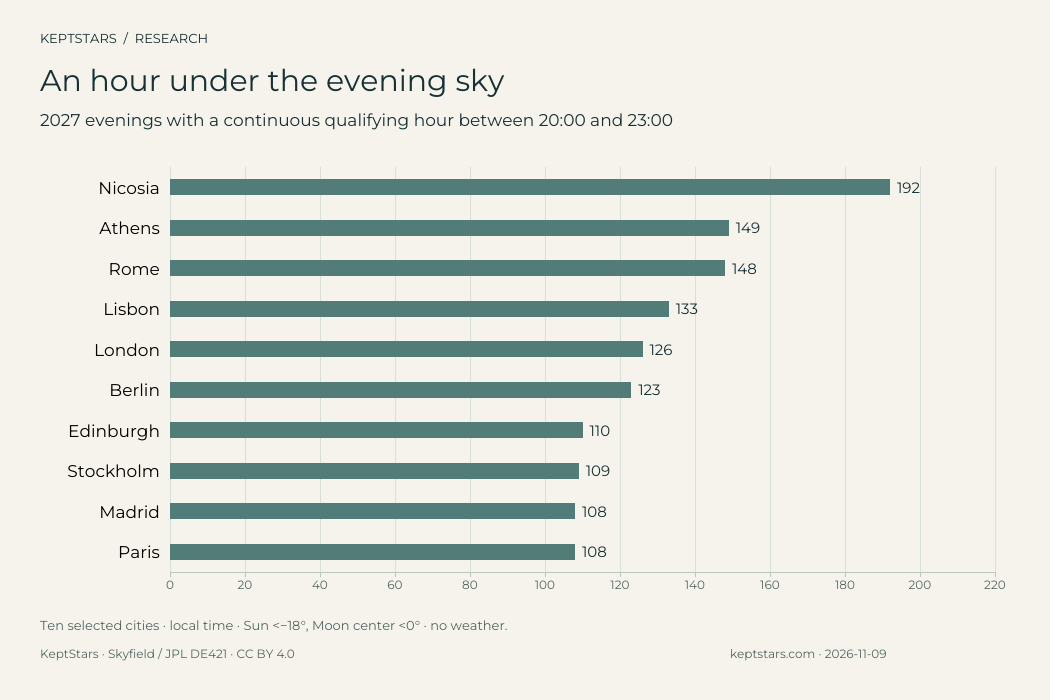
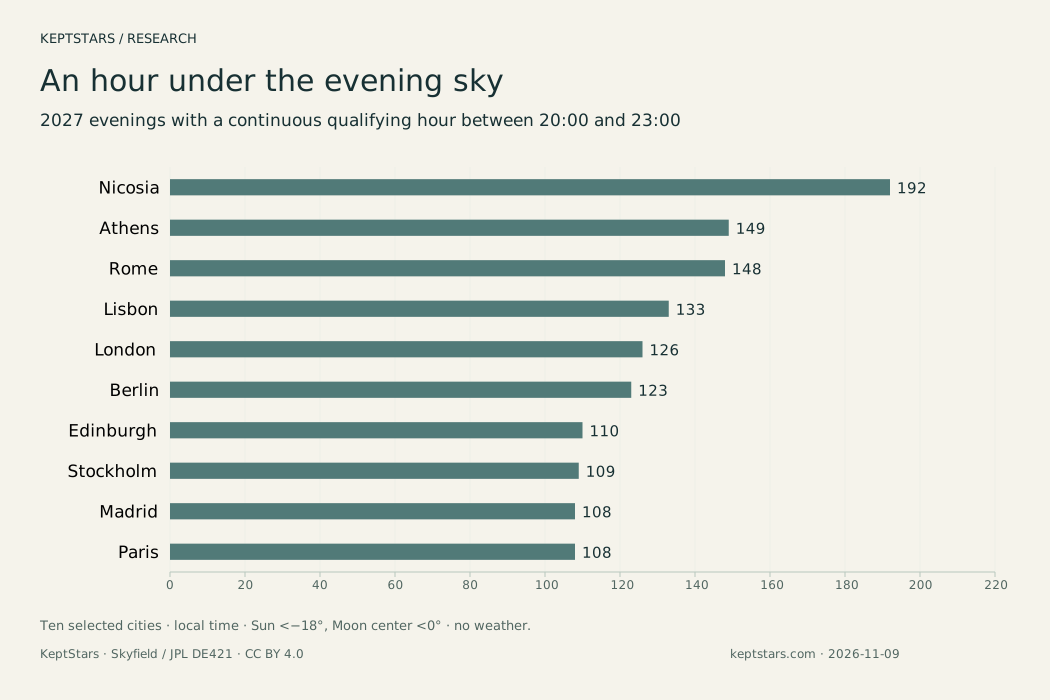
In our 2027 model, Nicosia has 192 evenings with at least one continuous hour of astronomical darkness and the Moon’s center below the horizon between 8 and 11 p.m. London has 126; Madrid and Paris each have 108. These are calculated opportunities, not forecasts of clear skies or rankings of the best stargazing destinations.
A dark night is less useful for an early bedtime if it starts after midnight. We calculated an evening calendar for ten European cities using the same local window: 8–11 p.m. The result is a practical starting point for choosing a date, before checking the weather and finding somewhere away from streetlights.
Which cities have an hour before 11 p.m.?
Nicosia leads this selected group with 192 qualifying evenings. Athens has 149, Rome 148 and Lisbon 133. London has 126, Berlin 123, Edinburgh 110 and Stockholm 109. Madrid and Paris each have 108.
These counts combine two conditions: the Sun must be at least 18 degrees below the horizon, and the Moon’s center must be below the geometric horizon. Both must hold for at least 60 consecutive minutes within the three-hour window. A date can have some dark minutes and still miss that threshold.
The comparison does not measure how many stars you will see. A cloudy evening qualifies in this calculation just as a clear evening would. City-center coordinates are reference points for the astronomy, not recommendations to observe from a brightly lit center.
| City | Qualifying evenings |
|---|---|
| Nicosia | 192 |
| Athens | 149 |
| Rome | 148 |
| Lisbon | 133 |
| London | 126 |
| Berlin | 123 |
| Edinburgh | 110 |
| Stockholm | 109 |
| Madrid | 108 |
| Paris | 108 |
Choose a city and month
The calendar below shows the longest qualifying stretch on each date. All times are local to the selected city, including its current daylight-saving rules for 2027. A dash means no continuous hour meets our two conditions before 11 p.m.; it does not mean there is nothing worth seeing.
Loading the data…
Why the local clock changes the comparison
Latitude controls how long summer twilight lasts. Longitude and the time zone also decide where that twilight falls on the clock. Our question is specifically about an early evening, so those clock differences are part of the result.
That is why this table should not be republished as a list of Europe’s darkest cities. We did not measure artificial light, cloud cover, air quality, access or safety. We selected ten cities to span different latitudes and clock positions; adding more cities could change the ordering.
You can still enjoy the Moon, bright planets or bright stars when our strict conditions fail. Moonlight is an obstacle for some faint targets, but the Moon is also a rewarding target itself.
Turn a calculated window into an actual outing
- Choose a listed window and check that its time fits your evening.
- Check a local weather forecast close to the date. This annual table cannot tell you whether there will be clouds.
- Choose a permitted place with an open view and less artificial light. Buildings, hills and trees can block part of the sky.
- Bring warm clothing and give your eyes time to adapt. Keep a bright phone screen out of your line of sight.
If you are choosing a shared evening with someone abroad, use our study of the sky shared by different cities. The same local hour in two cities is usually not the same instant.
How we calculated the calendar
We evaluated all 365 dates of 2027 in London, Edinburgh, Madrid, Paris, Rome, Berlin, Lisbon, Stockholm, Athens and Nicosia: 3,650 city-dates in total. For each date, we classified 180 one-minute intervals between 20:00 and 23:00 at their midpoints.
Skyfield 1.54 and JPL’s DE421 ephemeris provide topocentric apparent positions for the Sun and Moon. We use unrefracted altitudes at sea level: Sun center below −18° and Moon center below 0°. This Moon criterion differs from conventional moonset, which accounts for the disk’s upper edge and atmospheric refraction. A small part of the Moon can therefore remain observable near our boundary.
Reported durations and interval boundaries are estimates to the nearest minute. We checked eight Sun/Moon positions for London and Madrid against the separate Astronomy Engine implementation; the largest altitude difference was 0.064 arcminutes. This is a numerical cross-check, not validation of local observing conditions.
The calculation omits terrain, buildings, weather, light pollution and atmospheric refraction. Time zones follow current IANA rules; future legislation could change local times. The download gives the coordinates, daily results and reproducible method.
Download the data or cite a finding
Use the daily CSV to make a local calendar or compare months. Keep the 20:00–23:00 local window and the 60-consecutive-minute definition with any quoted count. Describe the dates as calculated windows rather than clear nights.
Suggested attribution: KeptStars Team, 2027 evening-sky calendar, published November 9, 2026; calculated with Skyfield and JPL DE421. Derived tables and charts are available under CC BY 4.0.
A memorable evening can become a personalized star map. For choosing a gift before you have a date, our stargazing gift guide starts with the recipient’s interests.
Download the data
- evening-sky-2027.csv · CSV
- Method and reproducible files · ZIP
- Reusable chart: PNG · SVG · PDF
CSV column names and reproducibility notes are in English. Charts and this article are localized.
CC BY 4.0 · KeptStars · Skyfield / JPL DE421 · CC BY 4.0
Does a qualifying date mean the sky will be clear?
No. The calculation includes the positions of the Sun and Moon, not weather. Check the local forecast before going out.
Can I still observe when no window is listed?
Yes. A date may have a shorter dark interval, darkness after 11 p.m., or good opportunities to see the Moon and bright planets. The study applies a specific early-evening threshold.
Are these times UTC or local?
Local to the city you select, using current time-zone and daylight-saving rules for 2027. The daily file also identifies each city’s IANA time zone.
Is Nicosia Europe’s best city for stargazing?
This study does not establish that. Nicosia has the most qualifying early-evening windows among our ten selected cities. We did not assess clouds, light pollution, observing sites or every European city.
Sources and notes
Research by KeptStars Team. Scope, assumptions and limitations are explained in the method section.